Affiliate links: as an Amazon Associate, Atelier Malin earns a commission if you buy, at no extra cost to you.
POTUINOM 165-disc assortment, 5-inch 8-hole (40 to 600 grit)
For a random orbit sander, this assortment covers everything from stripping to the final pass
Check the price on Amazon- 165 discs, 5-inch, 8 holes
- 9 grits, from 40 to 600
- 4.7/5 from 2,726 ratings
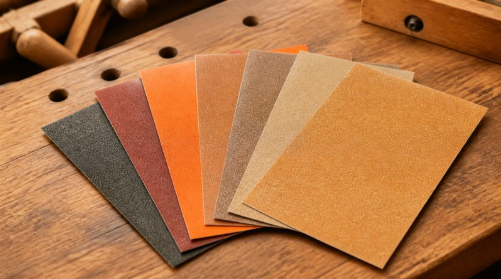
Which grit for which job: wood, paint, metal
The grit number tells you how coarse the abrasive is: the lower the number, the bigger the grains and the harder it cuts; the higher the number, the finer the grains and the smoother the surface it leaves. Here are the ranges you’ll reach for most often in the shop. More sanding guides live in our Sanding & Finishing section.
| Material / step | Recommended grit |
|---|---|
| Rough lumber, deep flaws, old finish | 60 to 100 grit |
| Wood, final sanding before stain or finish | 120 to 180 grit |
| Rusty metal or auto body | 40 to 80 grit (aluminum oxide) |
| Sound metal before primer | 180 to 240 grit |
| Paint, polyurethane or varnish, between coats | 220 to 400 grit |
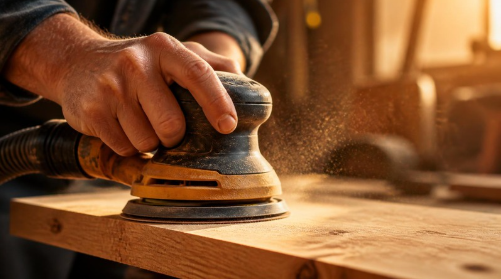
The rule that saves you from bad surprises: always work from the coarsest grit you need to the finest, never the other way around, and don’t skip more than one step at a time (80, 120, 180, not 80 then 180), or the scratches from the previous grit will show through the finish. And hook your sander to a vacuum: our best shop vac guide explains which filter actually catches fine sanding dust.
The “P” trap: CAMI vs. FEPA grits
A “400” isn’t always the same 400. Two grading scales share the shelves in the US: the American CAMI scale (also called ANSI), which shows only the number (400), and the European FEPA scale, recognizable by the “P” in front of the number (P400). Many assortments sold on Amazon.com are made overseas and graded on the P scale. From 40 to 220 grit, the two scales give almost identical particle sizes.
| CAMI grit (US, no “P”) | Average particle | Closest FEPA grit |
|---|---|---|
| 220 | 66 microns | P220 (65 microns) |
| 320 | 36 microns | P400 (35 microns) |
| 400 | 23.6 microns | P800 (21.8 microns) |
| 600 | 16 microns | P1200 (15.3 microns) |
Values from Klingspor’s coated abrasives grit chart, checked October 27, 2026. One micron is 0.00004 inch.
Two assortments that cover most jobs
Rather than buying one pack per grit, a mixed assortment means you never run out halfway through a project. We checked availability, ratings and prices on Amazon.com on October 27, 2026.
For a random orbit sander (5-inch hook-and-loop discs, 8 holes): the POTUINOM 165-piece assortment covers 40, 60, 80, 120, 150, 240, 320, 400 and 600 grit, 20 discs of each plus 5 extra 40-grit discs for stripping. That’s everything from rough removal to the final pass before finish, without a mid-project trip to the hardware store. $19.99 (checked October 27, 2026), rated 4.7/5 from 2,726 ratings, in stock. Check the price on Amazon.
For an orbital (1/4-sheet) palm sander or hand sanding (4-1/2 × 5-1/2 in. sheets): the Milescraft 1623 50-pack covers 80, 120, 150, 220 and 320 grit, and works wet or dry. $13.47 (checked October 27, 2026), rated 4.6/5 from 1,885 ratings, in stock. Check the price on Amazon.
Not sure which sander you need? Our orbital vs. random orbit sander guide explains what each one does best, and our Black Friday 2026 power tool deals page lists the sander prices to beat this fall.

When an assortment isn’t the right buy
- You’re only sanding drywall patches: a couple of 120 to 150-grit sanding sponges will do the job with less dust.
- You’re wet-sanding a car’s clear coat: you need silicon carbide wet/dry sheets from 1,000 grit up, not a woodworking assortment.
FAQ
What does the grit number on sandpaper mean?
It’s a measure of coarseness: the higher the number, the smaller the abrasive particles. On the FEPA “P” scale, P40 has particles of about 0.016 inch (412 microns) for stripping, P120 about 0.005 inch (127 microns) for prepping wood, and P240 about 0.0023 inch (58.5 microns) for sanding between coats.
What grit sandpaper should I use on bare wood?
Start with 60 to 100 grit to flatten rough lumber or remove a flaw, then finish with 120 to 180 grit before stain, paint or a clear finish.
What grit should I use between coats of paint or polyurethane?
A fine grit, between 220 and 400, is enough to lightly scuff the surface between coats without cutting through the finish.
Why doesn’t every “400 grit” sheet feel the same?
Because two scales coexist: the American CAMI scale (marked 400, no P) and the European FEPA scale (marked P400). Above 220 grit they diverge: a P400 is about as coarse as a CAMI 320, while a CAMI 400 is about as fine as a P800.
Do random orbit and orbital sanders use different sandpaper?
Yes, the format changes: round 5-inch hook-and-loop discs, usually with 8 holes, for a random orbit sander, and rectangular quarter sheets (4-1/2 × 5-1/2 in.) for an orbital palm sander. The grit you choose follows the same rules on both.
Our verdict
Our pick: the POTUINOM 165-disc assortment at $19.99, rated 4.7/5 from 2,726 ratings (checked October 27, 2026). Nine grits from 40 to 600 for less than the cost of redoing one finish, and you’ll never stall a project for lack of the right disc. Sanding by hand or with a palm sander? Add the Milescraft 1623 quarter-sheet pack at $13.47. Sandpaper is the most underrated consumable in the shop: keep at least two grits ahead in the drawer and your finishes will thank you.
Get the POTUINOM 165-disc assortment on Amazon →
See all our picks on our recommended tools page.