Affiliate links: as an Amazon Associate, Atelier Malin earns a commission if you buy, at no extra cost to you.

DeWalt DWE6423K
One sander for everything: a corded random orbit kit, ready to plug in
Check the price on Amazon- 4.8/5 from 4,357 Amazon.com ratings
- 5-inch random orbit, no swirl pattern
- Variable speed, dust bag and case included
Other options
🗓️ Prices checked on October 27, 2026. They move often: check them again before you buy.
Written by Julien · Reviewed by Nadia on 10/27/2026 (prices, links and availability checked) — our editorial pen names
Only buying one sander? Get a random orbit
The short answer: if you only buy one sander, make it a random orbit sander. Our pick is the DeWalt DWE6423K, a 5-inch corded kit at $98.99 on Amazon.com (checked October 27, 2026), rated 4.8/5 from 4,357 ratings. It removes material fast, leaves no swirl pattern on big flat surfaces, and you finish the corners by hand.
See the DeWalt DWE6423K on Amazon →In this article
Four sanders side by side · What actually matters · Who should skip a random orbit · FAQ · Our verdict
Orbital sander or random orbit sander: it’s the first question anyone setting up a shop asks, and the answer is less about brand or power than about the shape of the pad. This guide is part of our Sanding & Finishing section.
Four sanders to settle the question
These four are popular, well-reviewed picks on Amazon.com in each family. We put them side by side to help you pick a family, not to crown a brand: prices, ratings and rating counts were checked on Amazon.com on October 27, 2026.
| Sander | Type | Price (Oct 27, 2026) | Amazon.com rating | Best for |
|---|---|---|---|---|
| DeWalt DWE6423K | Random orbit, 5 in., corded | $98.99 | 4.8/5 (4,357 ratings) | Our pick ✅: one sander for everything |
| Makita XOB01Z | Random orbit, 5 in., 18V LXT | $111.37 (tool only) | 4.8/5 (2,848 ratings) | You already own Makita batteries |
| DeWalt DWE6411 | Orbital (1/4 sheet), corded | $69.99 | 4.8/5 (2,833 ratings) | Corners, edges, light finishing |
| Black+Decker BDERO100 | Random orbit, 5 in., corded | $39.99 | 4.6/5 (15,624 ratings) | The lowest budget |
DeWalt DWE6423K
$98.99
4.8/5 — 4,357 ratings (checked October 27, 2026)
random orbit · 5 in. hook-and-loop pad · 3.0 A · 8,000–12,000 OPM variable speed · dust bag and case
Good to know: it’s ready to plug in, so there’s no battery to budget for. Variable speed and DeWalt’s separate counterweight (to cut vibration) make it the sander you can hand to a beginner and keep for years.
Check the price on Amazon →Makita XOB01Z
$111.37
4.8/5 — 2,848 ratings (checked October 27, 2026)
random orbit · 5 in. · 18V LXT · 3 speeds (7,000 / 9,500 / 11,000 OPM) · tool only
Good to know: tool only, no battery or charger. If you already run Makita 18V LXT tools, it’s the cordless sander to get: no cord catching on the edge of a tabletop.
Check the price on Amazon →DeWalt DWE6411
$69.99
4.8/5 — 2,833 ratings (checked October 27, 2026)
orbital · 1/4-sheet pad (4-1/2 × 5-1/2 in.) · 2.3 A · 14,000 OPM · corded
Good to know: the point isn’t the price, it’s the shape: the square pad reaches inside corners and edges no round pad can touch. It also takes cheap standard sheets you cut yourself.
Check the price on Amazon →Black+Decker BDERO100
$39.99
4.6/5 — 15,624 ratings (checked October 27, 2026)
random orbit · 5 in. · 2.0 A · 12,000 OPM · corded · dust bag included
Good to know: with more than 15,000 ratings, it’s the most-reviewed sander on this page. A smart first sander for occasional projects: refinishing a chair, prepping a door for paint.
Check the price on Amazon →What actually matters when you choose
What’s the difference between an orbital sander and a random orbit sander?
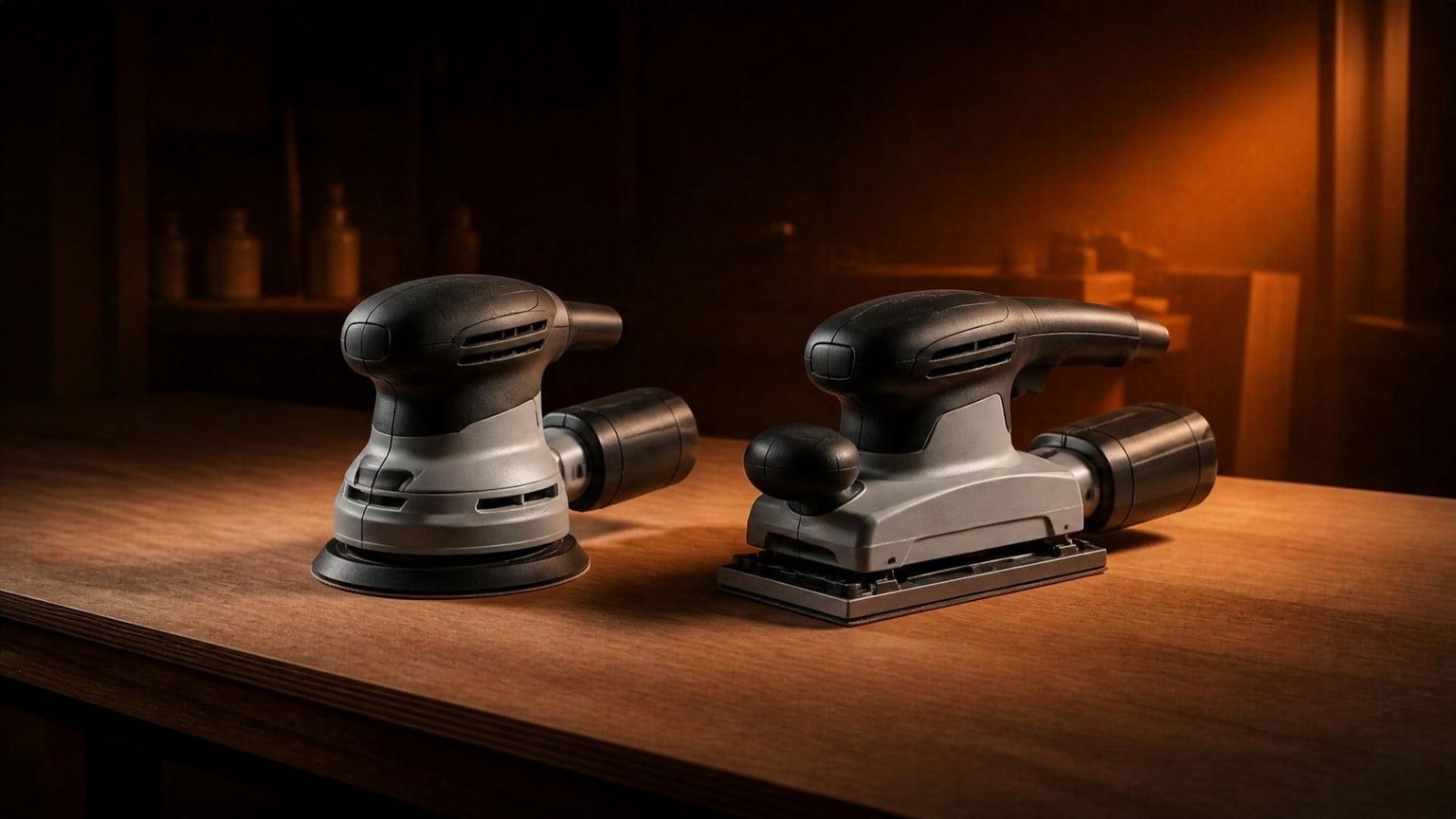
It comes down to the motion and the pad. A random orbit sander spins a round 5-inch pad while moving it in small ellipses: it removes a lot of material quickly without leaving a pattern on large surfaces. An orbital (or “sheet”) sander shakes a square pad in tiny circles: slower, but it reaches into corners and gives a fine finish.
The shape of the pad, and nothing else
That’s the whole question. The random orbit’s round pad spins and oscillates at the same time, so no two passes trace the same path and you don’t get repeated scratch marks. The orbital’s square pad vibrates in place: it gets into corners, edges and tight spots, but it leaves more visible swirls if you bear down. Power, brand and price all come after this difference.
The random orbit removes, the orbital finishes
At the same grit, a random orbit sander takes off far more material and works much faster on a big flat surface: a tabletop, a door, a countertop. An orbital sander is gentler and slower, made for scuff-sanding before paint and for small surfaces. Stripping an old finish off a dining table, the time difference is counted in hours. Pick the right paper too: our sandpaper grit guide tells you where to start and where to stop.
What a random orbit sander will never do
It can’t get into an inside corner. The round pad stops a fraction of an inch short, and forcing it against the wall chews up both the pad and the workpiece. It’s the family’s only real limit, and a $5 hand-sanding block handles it fine for home projects.
The detail sander, a third option
There’s a third family: the triangular detail sander (often called a “mouse” sander), made for tight spots like shutters, spindles and moldings. It doesn’t replace either of the other two and only makes sense if you sand that kind of surface often. Don’t buy it as your first sander.
Corded or cordless?
A corded sander like the DWE6423K runs as long as you do and costs less up front. A cordless one like the Makita XOB01Z is freedom on big pieces and outdoor jobs, but it only makes sense if you already own the batteries. If you’re about to pick a battery platform, start with our best cordless drill guide: the drill usually decides the brand. And connect the dust port to a vacuum: our best shop vac guide explains which filter keeps fine sanding dust out of the air.
Also on Atelier Malin
Who should skip a random orbit as a first sander
- You mostly sand inside corners, cabinet face frames or window sashes: start with the DeWalt DWE6411 orbital sander, and add a random orbit when the first big tabletop comes along.
- You’re sanding drywall or a ceiling: that’s a job for a long-reach drywall sander, not a handheld one.
FAQ
What’s the difference between an orbital sander and a random orbit sander?
The motion and the shape of the pad. A random orbit sander spins and oscillates a round pad at the same time, so it removes material faster. An orbital sander moves a square pad in small circles: slower, but it reaches corners and is mostly used for finishing.
If I only buy one sander, which should it be?
A random orbit sander, such as the DeWalt DWE6423K ($98.99 on October 27, 2026). It covers most jobs, from stripping and leveling to prep before finishing, and its one weak spot, corners, is easy to handle with a sanding block. The reverse doesn’t work: an orbital sander alone is slow and frustrating on large surfaces.
Why does my random orbit sander leave swirl marks?
Most often because the pad can’t spin freely: pressing too hard stalls the random motion and turns it into a regular circular pattern. Let the weight of the sander do the work. A clogged disc or a worn pad causes the same problem.
Can I use the same sandpaper on both sanders?
No. A random orbit sander takes round 5-inch hook-and-loop discs, usually with 8 dust holes. An orbital sander takes rectangular sheets, often a quarter of a standard 9 × 11-inch sheet (4-1/2 × 5-1/2 in.), held by clamps or hook-and-loop. Check the size and hole pattern before buying a pack.
Do I need a variable-speed sander?
It helps on heat-sensitive materials, like some plastics, varnishes and paints that gum up, where full speed melts more than it sands. On bare wood, full speed is almost always right. It’s a nice extra, not a deal breaker.
How long does a sanding disc last?
Less than you think: a few minutes of actual sanding on resinous softwood like pine, longer on hardwood. A disc that glides instead of biting is worn out, even if it looks fine. A fresh disc sands faster than a more powerful sander with a dull one.
Our verdict 🧰
Buy a random orbit sander first. The DeWalt DWE6423K at $98.99 is our pick if you want a corded kit that’s ready to plug in, with 4.8/5 from 4,357 ratings. Already on Makita 18V LXT batteries? The Makita XOB01Z at $111.37 (tool only) is the same job without the cord. On a tight budget, the Black+Decker BDERO100 at $39.99 gets you sanding today. Add the DeWalt DWE6411 orbital sander at $69.99 once corners start slowing you down: it completes a shop nicely. Stock up on fresh discs and you’ll get a smooth finish from the first project. More picks are on our recommended tools page and in our Sanding & Finishing guides.