Affiliate links: as an Amazon Associate, Atelier Malin earns a commission if you buy, at no extra cost to you.

Bosch GT2000 4-pc Glass & Tile Bit Set
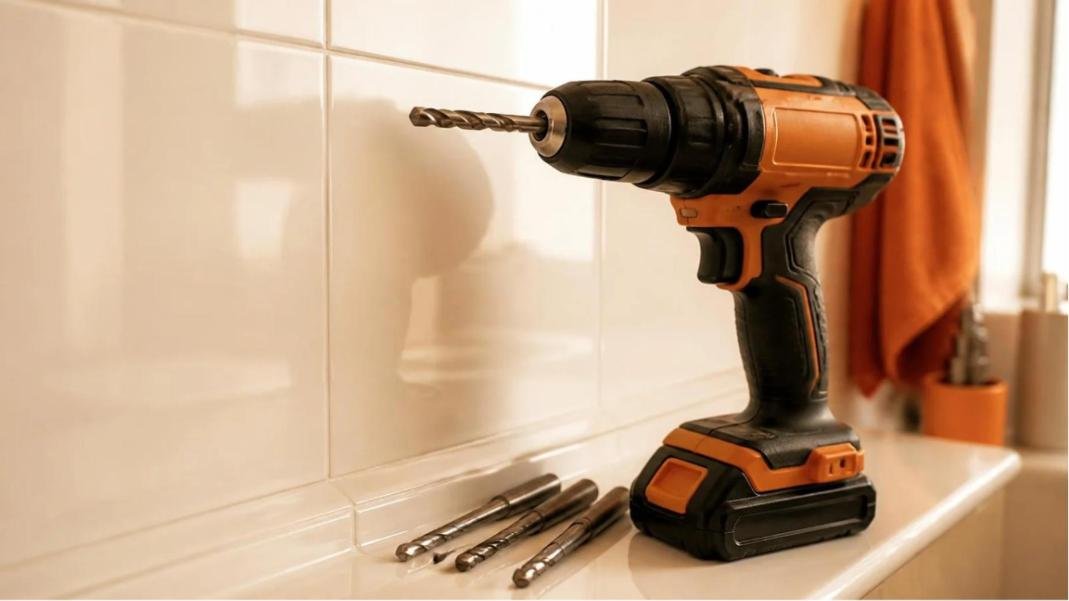
To drill ceramic wall tile or glazed floor tile without cracking it, this is the bit set to get
Check the price on Amazon- Carbide spear-point tip that doesn't walk
- 4.3/5 from 4,969 ratings
- $19.99, 43% below its list price
Other options
🗓️ Prices checked on October 27, 2026. They move often: check them again before you order.
Written by Julien · Reviewed by Nadia on 10/27/2026 (prices, links and availability checked) — our editorial pen names
The tile decides, not your budget
The short answer: for ceramic wall tile or glazed floor tile, a carbide spear-point bit is all you need: the Bosch GT2000 4-piece glass and tile set is $19.99 on Amazon.com (checked October 27, 2026), rated 4.3/5 from 4,969 ratings. For porcelain, only a diamond bit will do. Either way: hammer mode off, low gear, under 1,000 rpm.
See the Bosch GT2000 set on Amazon →In this article
Three tiles, two bits · The bits worth knowing · The number nobody gives you · The limits that keep coming up · When to skip the DIY route · FAQ · Our verdict
Three tiles, two bits: the only question to settle
You don’t really drill a tile, you grind through it. So the bit has to be harder than the tile, and hardness varies a lot from one tile to the next. Bosch rates tile hardness on a 1-to-10 scratch scale and says that any tile at 6 or above needs a diamond bit; dense porcelain can reach 8, while diamond itself sits at 10. This guide is part of our Drilling & Driving section.
In practice, you’re facing one of three cases. Ceramic wall tile: porous body under a thin glaze. Glazed ceramic floor tile: red or beige body with a thicker glaze. Porcelain tile: dense, the same color all the way through on many through-body tiles. The first two take a carbide spear-point bit. The third demands diamond, no exceptions.
| Tile | Where you find it | Hardness (1 to 10) | Bit to use |
|---|---|---|---|
| Ceramic wall tile | Bathroom and kitchen walls, backsplashes | 3 to 4 | Carbide spear point |
| Glazed ceramic floor tile | Floors, thicker glaze | 3 to 4 | Carbide spear point |
| Porcelain tile | Floors and walls, dense body | up to 8 | Diamond |
In every case: hammer mode off, low gear (under 1,000 rpm), and cool with water.
There’s a fourth option many people try first, and it’s usually the wrong one: the regular masonry bit from the drawer. Its blunt carbide tip is made to pound concrete, not to score glaze: on a slick tile it skates, and once it bites it tends to chip the edge of the hole. Bosch only places it in the middle of its hardness scale. A spear-point tile bit costs a few dollars more and starts exactly where you mark.
The bits worth knowing, and which tile they’re for
Prices, average ratings, rating counts and availability checked on Amazon.com listings on October 27, 2026.
| Product | Price (Oct 27, 2026) | Amazon.com rating | For |
|---|---|---|---|
| Bosch GT2000 4-pc glass & tile set | $19.99 (list $34.99) | 4.3/5 (4,969 ratings) | Our pick ✅: ceramic wall and floor tile |
| DKIBBITH 10-pc dry diamond bit set | $17.99 | 4.3/5 (2,300 ratings) | Porcelain, 3/16 to 1/2 in. |
| ZNXIMER 11-pc diamond hole saw kit | $33.49 (list $66.99) | 4.6/5 (196 ratings) | Big holes, 1/4 to 2-1/2 in. |
| THINKWORK diamond kit with suction-cup guide | $33.99 | 4.3/5 (195 ratings) | Beginners who fear skating |
| Franklin Sensors ProSensor M210 | $59.97 | 4.6/5 (6,608 ratings) | Before you drill: studs and live wires |
Bosch GT2000 4-pc Glass & Tile Bit Set
$19.99
4.3/5 · 4,969 ratings · in stock (checked October 27, 2026)
carbide spear-point tip · reinforced head · three-flat shank · 4 common sizes
Good to know: this is the bit for wall tile and glazed ceramic. The precision-ground point stops it from walking on the glaze. On porcelain it will glaze over and heat up: that’s not a defect, it’s simply outside its range.
Check the price on Amazon →DKIBBITH 10-pc Dry Diamond Drill Bit Set
$17.99
4.3/5 · 2,300 ratings · in stock (checked October 27, 2026)
vacuum-brazed diamond · wax coolant inside · 3/16 in. (×2), 1/4 in. (×5), 5/16, 3/8, 1/2 in. · round shank
Good to know: about $1.80 a bit, with extra 1/4-inch bits for the size you’ll use most. A diamond bit doesn’t start in a center-punch dimple: begin at an angle, then bring the drill upright.
Check the price on Amazon →ZNXIMER 11-pc Diamond Hole Saw Kit
$33.49
4.6/5 · 196 ratings · in stock (checked October 27, 2026)
vacuum-brazed diamond · 1/4 to 2-1/2 in. · hex shank for any drill · water sponge and core ejection spring
Good to know: the best-rated product here, half off its $66.99 list price. It’s the kit for faucet, shower valve and drain openings; overkill if you only ever drill 1/4-inch holes for anchors.
Check the price on Amazon →THINKWORK Diamond Kit with Suction-Cup Guide
$33.99
4.3/5 · 195 ratings · in stock (checked October 27, 2026)
double suction-cup guide (fits holes from about 3/16 to 3-1/4 in.) · 10 brazed diamond bits, 1/4 to 2 in.
Good to know: the guide solves the real beginner problem, the bit wandering across the glaze. Its rating rests on fewer ratings than the Bosch set: buy it for the guide, which locks the bit exactly on your mark.
Check the price on Amazon →Franklin Sensors ProSensor M210
$59.97
4.6/5 · 6,608 ratings · in stock (checked October 27, 2026)
13 sensors · wood and metal studs up to 1.7 in. deep · live wire detection · built-in level
Good to know: it doesn’t make the hole, but it decides where you make it. Bathrooms and kitchens hide wiring behind the tile, and a cracked tile is cheaper than a nicked cable. Finding the stud also tells you where a heavy shelf will really hold.
Check the price on Amazon →If what you’re missing is the drill rather than the bit, our best cordless drill guide covers the models, and our best SDS-plus rotary hammer guide covers the next step: the concrete or block wall behind the tile. Not sure which of the two you need? Read hammer drill vs. rotary hammer.
 How we chooseWe start from the tile, never from the price tier. We only keep a feature if the manufacturer lists it. And we tell you when an average rating rests on too few ratings to settle the question.
The number nobody gives you: 1,000 rpm
Read the tile tutorials and one point comes up everywhere without ever being put into numbers: everyone says “go slow,” almost nobody says how slow. They talk about “low speed,” “taking your time,” “not forcing it.” Bosch’s tile-drilling guidance does give the number: when drilling tile, the bit should not turn faster than 1,000 rpm. Rubi, the tile-tool maker, adds that the bigger the diameter, the lower the speed.
That number changes everything once you hold it up against real drills. A DeWalt DCD771 runs at 0–450 rpm in first gear and 0–1,500 rpm in second. A Milwaukee M18 2801-20 goes from 0–500 to 0–1,800 rpm. On two popular compact drills, second gear overshoots the limit by 50% to 80% at full trigger, while first gear stays well under it, trigger fully squeezed.
What that means in practice
On tile, the gear selector isn’t a comfort setting, it’s a safety stop. In gear 1, you can’t exceed the limit even if you squeeze the trigger all the way; in gear 2, you’re out of range the moment you start. That’s probably why so many tiles crack with the right bit: the bit was right, the gear wasn’t. And hammer mode goes off: the blows are what split the glaze.
The second point everyone agrees on is about money. A good carbide set costs $19.99 and a diamond set $17.99 at today’s prices. Replacing a cracked tile means chiseling it out, finding a match (often discontinued a few years after install) and regrouting. The right bit always costs less than the mistake it prevents, and it’s the one tool decision that needs no math.
The limits that keep coming up
Drilling in the grout line isn’t the easy way out it seems. It’s the most repeated tip, and it has a measurable limit: a typical wall grout joint is about 1/16 to 1/8 inch wide. A 5/16-inch anchor won’t fit, and a 5/16-inch bit will bite into the tiles on either side and chip them. Grout joints are fine for small screws, not for a medicine cabinet.
Know when to stop. Most tiles are about 5/16 to 7/16 inch thick. Once you’re through, switch to a masonry bit for the wall behind: tile, glass and diamond bits wear out fast in masonry, and hammering a tile bit into concrete ruins it.
Heat cracks tile as much as pressure does. Overheating builds stress in the tile until it splits. Dry diamond bits with a wax core handle it on their own; the others need help: a trickle of water, or a wet sponge held under the hole. Most tutorials mention water, but few connect it to cracking. That’s the mechanism.
Two free tricks do the rest: an X of painter’s tape over the mark, which keeps the point from skating on the glaze, and a light center-punch dimple, useless with a diamond bit but essential with carbide. Finally, vacuum the dust straight from under the hole: a shop vac beats a rag every time.
When to skip the DIY route
- A hole wider than 2-1/2 inches (a new shower drain or a recessed fixture): that’s a job for a wet core rig or a tile pro.
- Tempered glass tile or a glass shower panel: it can’t be drilled after tempering, with any bit.
FAQ
What drill bit should I use to drill tile without cracking it?
For ceramic wall tile or glazed floor tile, a carbide spear-point bit such as the Bosch GT2000 set ($19.99 on October 27, 2026). For porcelain, which can reach 8 on a 10-point hardness scale, only a diamond bit will do. A regular masonry bit is a poor fit for either.
What speed should I use to drill tile?
Bosch’s guidance is no more than 1,000 rpm. On a two-speed drill, that means staying in gear 1: a DeWalt DCD771 tops out at 450 rpm there and a Milwaukee 2801-20 at 500, while their second gear reaches 1,500 and 1,800 rpm.
Should I turn off hammer mode to drill tile?
Yes, every time. The blows from hammer mode split the glaze and crack the tile. Only turn it back on once you’re through the tile and have switched to a masonry bit for the wall behind it.
Can I drill into the grout instead of the tile?
Only for small fasteners. A wall grout joint is about 1/16 to 1/8 inch wide: any bigger bit bites into the neighboring tiles and can chip them. For a medicine cabinet or a heavy load, drill through the tile.
How deep should I drill with a tile bit?
Just through the tile, usually 5/16 to 7/16 inch. Then switch to a masonry bit: tile, glass and diamond bits wear out very quickly in masonry and lose their bite.
Our verdict
Hanging towel bars on standard ceramic wall tile? Grab the Bosch GT2000 set at $19.99, gear 1, hammer off, painter’s tape on the mark: clean holes on the first try. Porcelain floor or wall: the DKIBBITH diamond set at $17.99, or the ZNXIMER hole saw kit at $33.49 for faucet and valve openings. Nervous about the bit skating? The THINKWORK kit at $33.99 puts the bit exactly on your mark. And scan the wall with the Franklin ProSensor M210 before the first hole. To choose the drill itself, everything is on our recommended tools page.